What Is ABX? a Definition Guide for Home Service Contractors
96% of visitors to home service websites don’t fill out a form, leaving potential revenue on the table. ABX, or Account-Based Experience, gives your crew a way to recognize and coordinate around those otherwise anonymous visitors, from the first page view through the completed job and future service.
The phrase sounds like enterprise software jargon, but the working principle fits a local HVAC, plumbing, roofing, electrical, garage door, or landscaping business. You already organize work around a property, household, or commercial location. ABX adds shared customer context so your marketing, office staff, salespeople, and technicians act on the same information.
Table of Contents
- The Reality of Lost Revenue
- Decoding the Three Meanings
- Mastering Account-Based Experience
- Applying ABX to Your Home Service Business
- Building a Workflow That Converts
- Quick Reference - Comparing ABX Definitions
The Reality of Lost Revenue
A homeowner lands on your furnace replacement page, checks financing information, then leaves to compare providers. Your office never sees a name or phone number. Two days later, that homeowner calls a competitor who responds with a clear estimate and an available appointment.
That visitor wasn’t necessarily uninterested. They may have been researching after hours, comparing options, or waiting to discuss the project with another decision-maker. A form-only process records nothing, so your crew has no opportunity to respond while the need is active.
Why anonymous activity matters
Traditional lead reporting counts calls, forms, and booked jobs. Those metrics matter, but they ignore the large group of visitors who show interest without identifying themselves. ABX treats useful website behavior as account context, then connects that context to a relevant next action.
For a contractor, the account may be a household, property, or commercial site. The record can include service interest, previous jobs, estimate activity, appointment history, and communication preferences. Your dispatcher doesn’t need a vague “website lead.” They need to know that a property viewed emergency plumbing, financing, and service-area pages before someone calls.
Practical rule: Capture the customer context your crew can act on. Ignore data that never changes a call, estimate, appointment, or follow-up.
ABX matters because it coordinates the experience after that first signal. The office can use the same context as the estimator, technician, and customer-success process, so the homeowner doesn’t have to repeat the story at every step.
Decoding the Three Meanings
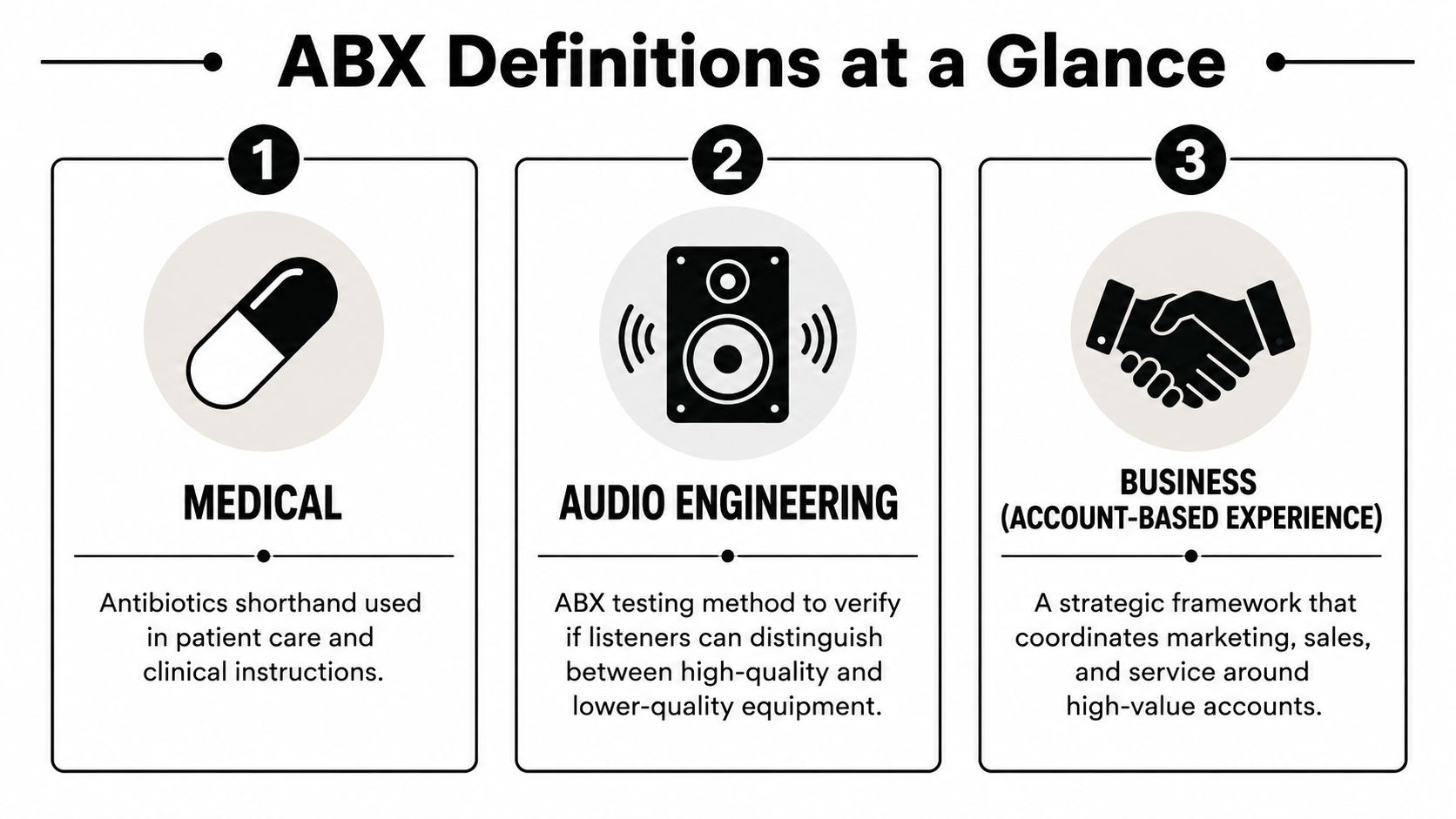
ABX has three established meanings. The right interpretation depends on the field using it.
| Context | Definition | Primary Use |
|---|---|---|
| Medical | Shorthand for antibiotics | Clinical instructions and patient care |
| Audio engineering | A testing method that checks whether listeners can distinguish between audio options | Equipment and listening evaluation |
| Business | Account-Based Experience, a coordinated account-level revenue model | Marketing, sales, service, and customer lifecycle management |
In healthcare, ABX commonly abbreviates antibiotics. Clinicians may use it in treatment documentation, where the surrounding medical context determines its meaning.
In professional audio, ABX testing presents known audio options alongside an unidentified option. The listener identifies whether the alternatives sound different. The term belongs to controlled equipment and listening evaluation, not customer acquisition.
For a contractor, Account-Based Experience is the useful definition. It extends account-based marketing by coordinating marketing, sales, and customer-success interactions around defined target accounts and their buying journey, as described in this Account-Based Experience overview.
That distinction prevents the wrong operating model. A medical abbreviation cannot guide estimate follow-up, and an audio test cannot prioritize a homeowner researching replacement options. Business ABX connects account behavior to a coordinated response, including activity from the anonymous visitors who make up much of website traffic.
If you need to identify those visitors and connect their activity with business records, review this guide to visitor identification. Use the result only when it can improve routing, follow-up, or service timing.
Mastering Account-Based Experience
Account-Based Experience treats the account as the central unit of engagement. In a home service company, that account is usually a property or household, not just one phone number in a CRM.
ABX coordinates the customer journey across advertising, website pages, sales outreach, onboarding, job completion, renewal, and expansion. The office staff should see enough context to route the request correctly. The technician should know what the customer already discussed. Follow-up should reflect the completed work instead of starting from a blank record.
Use the account as the working record
Build your process around three operating requirements:
-
Define priority accounts. Group properties by service value, geography, property type, urgency, or existing relationship. A commercial maintenance account and a one-time residential repair shouldn’t receive the same workflow.
-
Share behavioral context. Track service pages, pricing pages, financing information, integration or technical content where relevant, estimate requests, calls, and previous interactions. The data needs to reach the people responsible for the next customer action.
-
Coordinate the response. Match the signal to the next step. Repeated visits to an emergency-service page deserve fast office attention. A completed installation should trigger clear handoff, care information, review outreach, and future maintenance communication.
ABX became a mainstream direction within account-focused B2B marketing. In the 2024 ABM Benchmark Study, 64% of marketers said their teams had an account-based or target-account approach, according to 6sense’s 2024 ABM Benchmark Study. Your local business doesn’t need an enterprise stack to apply the underlying discipline.
The useful test: If marketing, sales, and service use shared account information to coordinate multiple interactions, you’re practicing ABX. If each department works from isolated lists, you’re running separate campaigns.
Applying ABX to Your Home Service Business
Start with the customer unit you already understand. For residential work, use the property or household. For commercial service, use the location or operating account. Add the people connected to that account, such as the homeowner, property manager, tenant, office administrator, or facilities contact.
Then connect website behavior to the service workflow. A homeowner who visits a water-heater replacement page needs a different response from someone reading a general maintenance article. A property manager reviewing commercial service plans belongs in a different priority group from a one-time residential caller.
Turn signals into field actions
Use simple rules your crew can follow:
- Service interest: Route visitors who repeatedly view a specific service page to the matching office or sales queue.
- Urgency: Prioritize emergency, outage, damage, or same-day service behavior for rapid human contact.
- Project value: Give replacement, remodel, maintenance-plan, and commercial inquiries a defined owner.
- Customer history: Suppress generic acquisition messages when the account already has an open estimate, appointment, or service conversation.
- Post-job care: Continue the account experience after completion with maintenance reminders, documentation, review requests, and relevant future-service outreach.
First-party information earns its keep right here. A practical explanation of first-party data for contractors can help your team separate useful customer-owned context from disconnected advertising signals.
The model also improves your route and office planning. If several priority properties show interest in the same service area, your team can align scheduling, technician availability, and follow-up instead of treating every inquiry as an isolated event.
For broader local-search and customer-acquisition guidance, Bruce and Eddy’s 2026 advice for service-based businesses offers a useful companion resource.
In a 2025 survey of B2B companies, 77% of organizations running account-based marketing reported increased pipeline, while 55% saw higher win rates, according to NRich’s State of ABM Report. Those figures describe B2B account programs, not a guaranteed result for contractors. The practical lesson is to measure account movement, not just traffic.
Building a Workflow That Converts
Your workflow needs four connected stages: targeting, engagement, conversion, and growth. Keep the structure simple enough for an office manager to operate and a technician to understand.
Start with signals
Choose the behaviors that indicate a real service need. Pricing, financing, replacement, emergency, service-area, integration, and case-study pages can reveal more than a generic homepage visit. Combine anonymous activity with known account details when identification becomes available.
Create a priority rule for each signal. For example, repeated pricing activity can create a call task, while a completed estimate can trigger a structured follow-up sequence. Don’t send every visitor the same email. Match the message to the page, prior interaction, service type, and account stage.
Assign one next action
Every meaningful signal needs an owner and deadline. The action could be an office call, an SMS, an email with estimate details, or an alert to a salesperson. Suppress messages that conflict with an active conversation, scheduled appointment, or customer-success issue.
A standardized process also protects your brand. Homeowners shouldn’t receive a maintenance promotion while waiting for an update on a delayed repair. Your dispatcher shouldn’t promise information the technician has already provided. Shared account context reduces those avoidable mistakes.
Use a consistent estimate and invoice format so the commercial record supports the customer experience. An estimate invoice template for 2026 from AurenWell can help your team organize that documentation.
Measure account movement
Track whether priority accounts move from research to contact, estimate, appointment, completed work, and future service. Review buying-group coverage for commercial properties, response relevance, pipeline, win rate, retention, and expansion. Activity counts alone won’t tell you whether the workflow is working.
For automated reminders and task routing, follow-up automation for contractors shows how to turn defined triggers into repeatable actions without relying on memory.
Quick Reference - Comparing ABX Definitions
Use the surrounding conversation to interpret ABX quickly:
- In clinical notes, ABX means antibiotics.
- In audio forums, ABX testing means comparing known and unidentified audio options.
- In revenue operations, Account-Based Experience means coordinating work around one account.
The business definition matters to contractors because it turns anonymous interest into assigned work. That matters when 96% of traffic does not convert through a form. A useful signal can still create a task before a homeowner calls.
Apply the business meaning at four points in the job:
- Before contact: watch for service, pricing, financing, or urgency signals. For example, a property views financing and emergency plumbing pages twice in 48 hours. Create a same-day call task for the office.
- During sales: give the estimator the context needed to address the likely concern, such as payment options or response time.
- During delivery: pass the promised scope, job details, and customer expectations to the field team.
- After completion: schedule maintenance reminders, review requests, retention outreach, or relevant additional work.
Keep the workflow small enough for a busy office. Define the account, name the signal, assign an owner, set a deadline, and record the outcome. Start with one service line and review website visits, estimates, calls, and open jobs from the previous week. The goal is a booked appointment or completed job, not a larger activity report.
Pipeline On helps home service contractors identify homeowners who browse without submitting a form, then connect those profiles to tools such as ServiceTitan, Housecall Pro, Jobber, HubSpot, and Pipedrive. Visit Pipeline On to see how account-level visitor identification and automated follow-up can help your crew recover more opportunities from the traffic you already pay to attract.
Written by
Pipeline Research Team