Virtual Paralegal Services: What They Are & How to Hire

Virtual paralegal services draw on a U.S. labor base of about 404,900 paralegal and legal-assistant jobs in 2025, with roughly 40,800 openings a year projected through 2035, so the supply of qualified remote help is real and steady. That matters because the model works best when you treat it as supervised legal support, not as a shortcut around staffing.
Table of Contents
- What Virtual Paralegal Services Actually Are
- How the Trade Looks Day to Day
- Three Pricing Models and When Each One Wins
- What a Virtual Paralegal Can and Cannot Do
- How LatHire Can Help
- Security Architecture That Actually Holds
- Cross-Border and Compliance Risk Beyond the NDA
- Sourcing, Vetting, and Running a Pilot Engagement
- A 30-60-90 Day Rollout and the Questions Worth Asking First
What Virtual Paralegal Services Actually Are
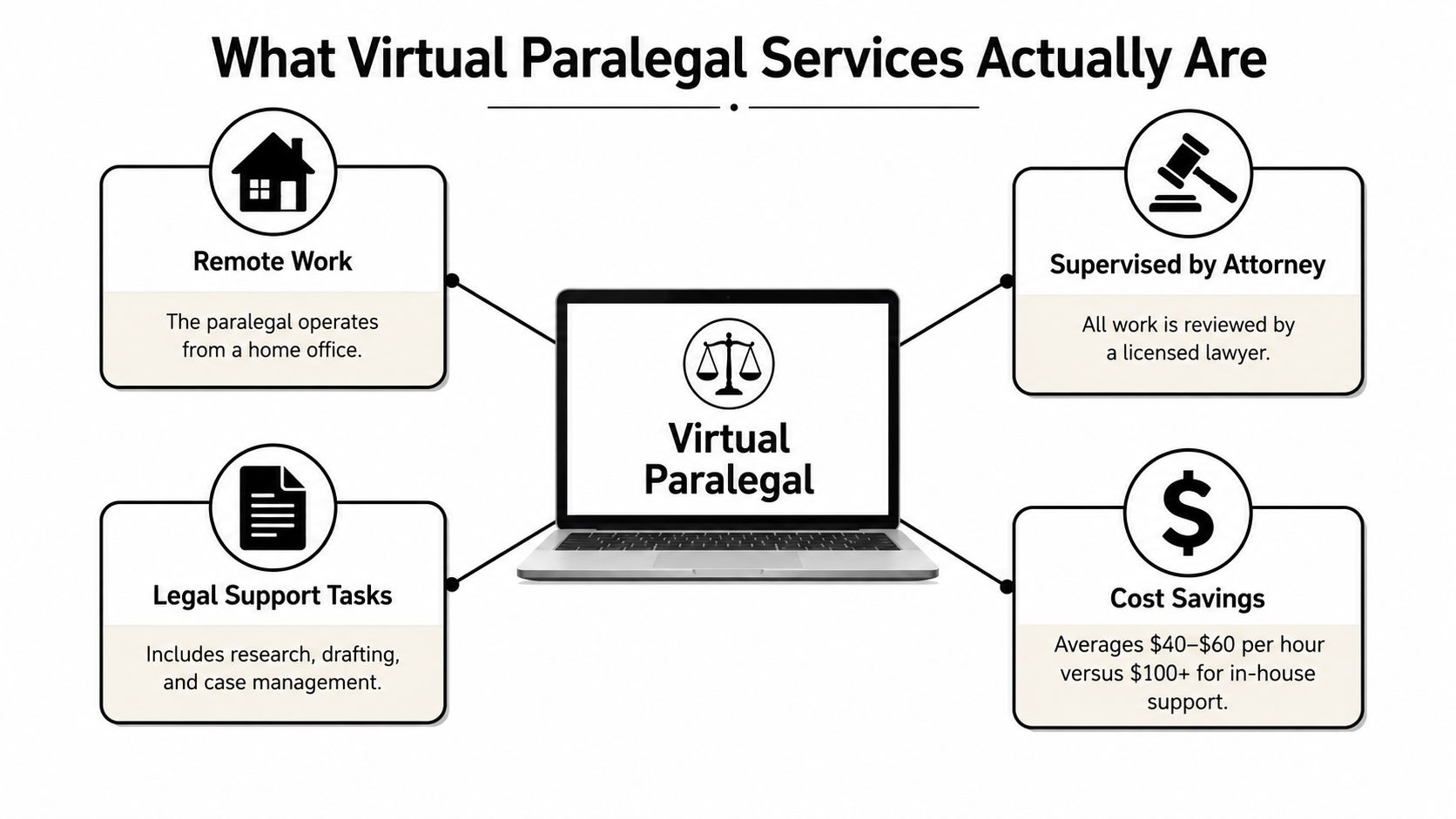
Virtual paralegal services are remote, supervised legal support done outside a law firm’s physical office. The lawyer keeps responsibility, the paralegal handles defined support work, and the firm gains capacity without adding another desk. A U.S. labor base of about 404,900 paralegal and legal-assistant jobs, with roughly 40,800 openings a year projected through 2035, shows that this model is backed by a real, steady workforce (BLS paralegals and legal assistants).
What the model includes
The American Bar Association describes remote legal assistance as work done from outside a traditional office on a full- or part-time basis, including legal research, document preparation, case management, e-discovery, and administrative support (ABA remote paralegals review). That is the service firms buy.
Good virtual paralegal work lives inside your supervision system. It follows your templates, your review process, and your file standards. It turns messy matters into usable work product without pretending to replace the lawyer.
It is not an offshore document mill, and it is not an AI draft factory. It is a human legal-support function that has to be controlled like one.
Practical rule: if a lawyer cannot review, correct, and sign off before the work leaves the firm, it does not belong in a virtual paralegal workflow.
How the Trade Looks Day to Day
A payment dispute, a contract fight, or a stack of unpaid accounts is where the work starts. The virtual paralegal does not pick the legal theory. The paralegal gathers the file, sorts the facts, and gets the attorney to a decision faster.
A contractor has a disputed install and a customer who refuses to pay. The paralegal pulls the signed agreement, photos, invoices, texts, emails, and change orders into one fact file. The attorney decides whether the matter calls for a demand letter, a collections route, or a lien-related step, then reviews anything that leaves the firm.
What you actually get back
The value is concrete. You hand over a mess, and you get back a package your office can use without rebuilding it from scratch.
For document-heavy matters, the U.S. Bureau of Labor Statistics lists gathering, organizing, and maintaining legal documents and drafting correspondence and legal documents such as contracts as core paralegal duties (BLS paralegals and legal assistants). That is why virtual paralegals fit lien prep, collections, vendor disputes, intake follow-up, and discovery organization. They handle the grind that eats your day.
A clean workflow usually looks like this:
- Fact file assembly: the paralegal gathers invoices, photos, notices, correspondence, and timelines.
- Draft preparation: the paralegal drafts letters, forms, and document sets for review.
- Deadline control: the paralegal tracks dates, hearing windows, and filing cutoffs.
- Attorney review: the lawyer checks the substance, approves the strategy, and sends the final version.
Security and supervision decide whether the workflow helps or hurts the firm. Shared drives, logged review steps, and a lawyer who reviews the work keep the file under control. Without that, the process turns into a cleanup job for the attorney.
A bad workflow is predictable. The contractor sends a vague email, the paralegal guesses at the task, and the office finds the missed deadline only after the client complains. That failure sits with supervision, not with the virtual model itself.
Three Pricing Models and When Each One Wins
The pricing model should match the control problem, not the sales pitch. A cheap rate means nothing if the work arrives late, the scope keeps shifting, or your office has to babysit every draft.
The median annual wage for U.S. paralegals and legal assistants was $60,970 in May 2023, with the lowest 10% below $39,710 and the highest 10% above $98,830 (BLS paralegals and legal assistants). Use that band as a reality check. If a quote sits far outside it, ask what you are buying: labor, supervision, responsiveness, or just a name on an invoice.
Hourly project work
Hourly work fits a single dispute, a collections batch, or a matter that flares up and then goes quiet. You pay for the task in front of you, and you keep the commitment narrow.
Use this model when the scope is tight and the finish line is clear. It is a poor fit for recurring work, because scattered billing makes review harder and adds friction every time the file comes back.
Monthly retainer
A retainer makes sense when the same work keeps returning. Recurring collections, steady intake support, and ongoing document prep all fit here.
The trap is a minimum block of hours your office never uses. If the vendor wants a floor, make sure the firm’s actual monthly volume supports it before you sign. Otherwise you are paying for idle capacity.
Dedicated FTE-equivalent
This model works for a multi-lawyer firm or a solo practice with steady volume and a real review process. You are buying available capacity, not just task completion.
That only works if the supervising attorney can assign work, check drafts, and approve changes quickly. Without that control, a dedicated arrangement turns into paid downtime.
| Model | Typical Rate | Best For | Watch Out For |
|---|---|---|---|
| Hourly project work | Variable, often anchored around the paralegal wage range | One-off matters, short bursts, clean scopes | Rush fees, setup charges, and weak scoping |
| Monthly retainer | Fixed monthly fee tied to a set service level | Recurring caseloads and predictable volume | Minimum hours you won’t use |
| Dedicated FTE-equivalent | Ongoing capacity priced like a standing resource | Busy firms with regular volume | Paying for availability your office can’t manage |
What a Virtual Paralegal Can and Cannot Do
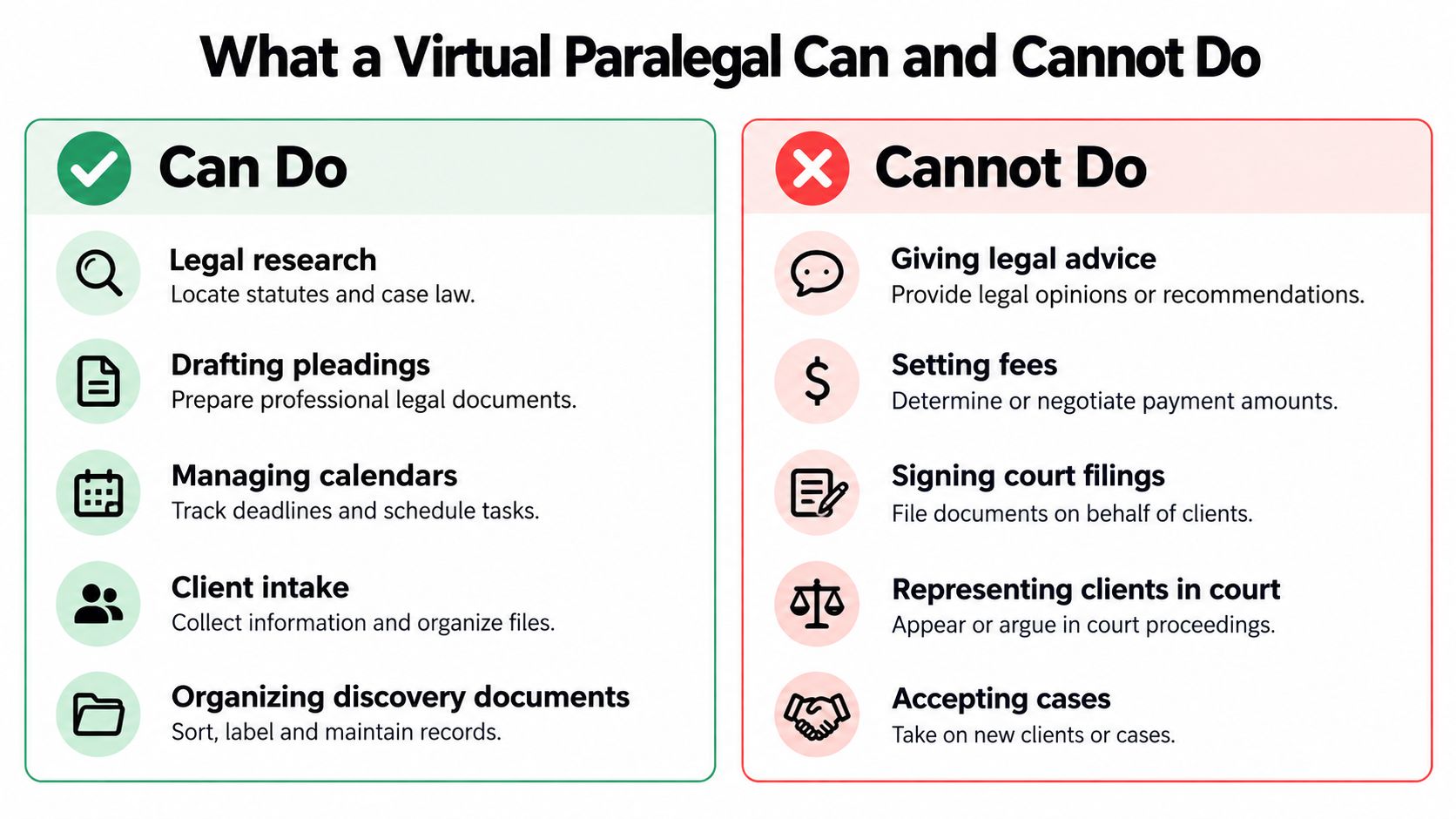
A virtual paralegal can do serious legal-support work, but the line is hard. The paralegal prepares and organizes. The lawyer decides and signs off.
The work that fits
The National Association of Legal Assistants prohibits paralegals from giving legal opinions or advice, setting fees, establishing attorney-client relationships, and representing clients in court without authorization (NALA model standards). That leaves a long list of work that absolutely does fit.
A virtual paralegal can:
- Research law and procedure for the supervising attorney.
- Draft correspondence and legal documents for review.
- Organize discovery and index case files.
- Track deadlines and manage calendars.
- Prepare filings for attorney approval before anything goes out.
- Handle intake support under written direction.
That division is the whole game. For a roofing company in a payment dispute, the paralegal can build the evidence packet, draft the demand letter, and prepare the filing stack. The attorney decides whether the letter should go, what it should say, and whether the matter belongs in court.
The work that stays with the lawyer
Federal court guidance says delegation is proper only when the lawyer keeps a direct client relationship, supervises the delegated work, and retains complete professional responsibility for the work product. It also says establishing the attorney-client relationship, setting the fee, and rendering a legal opinion are non-delegable lawyer duties (federal delegation guidance).
That means the lawyer owns the hard calls. A virtual paralegal can prepare the materials for a lien issue, but the lawyer decides whether the filing is correct and whether the client’s facts support it. A virtual paralegal can organize a collections file, but the lawyer decides whether to send suit papers or keep negotiating.
Bottom line: if the task requires legal judgment, client commitment, or courtroom authority, it belongs to the attorney.
How LatHire Can Help
LatHire is a hiring platform for companies that need pre-vetted remote professionals across operations, and its value here is simple. If a firm wants vetted support instead of cold-posting a role and sorting through weak fits, a platform with screening, background checks, and compliance support cuts the noise.
The practical use case is straight forward. A small firm can compare candidates faster, review validated profiles, and move on a workflow without turning hiring into a second job. For firms that want a broader candidate pool and a faster matching cycle, the resource at virtual paralegal services is a useful place to start.
HireParalegals.com focuses on remote paralegals, legal assistants, and intake specialists for law firms. For teams facing a backlog of records requests, document organisation, or client follow-up, that legal staffing focus is relevant to the work they need covered. Firms should assess candidates for practice-area experience, familiarity with their case management software, and accuracy on a representative task before making a hiring decision.

When a platform makes sense
Use a platform when the firm needs speed, screening, and a cleaner hiring process than a generic job board can provide. Skip it if the firm can’t define the role, the supervision structure, or the data-access rules first.
That’s the true filter. Good hiring solves a capacity problem, but only if the firm already knows what work the paralegal will touch and who signs off on it.
Security Architecture That Actually Holds
An NDA doesn’t make remote legal work safe. Security is a system, and every layer needs a control that delivers results.
The five layers that matter
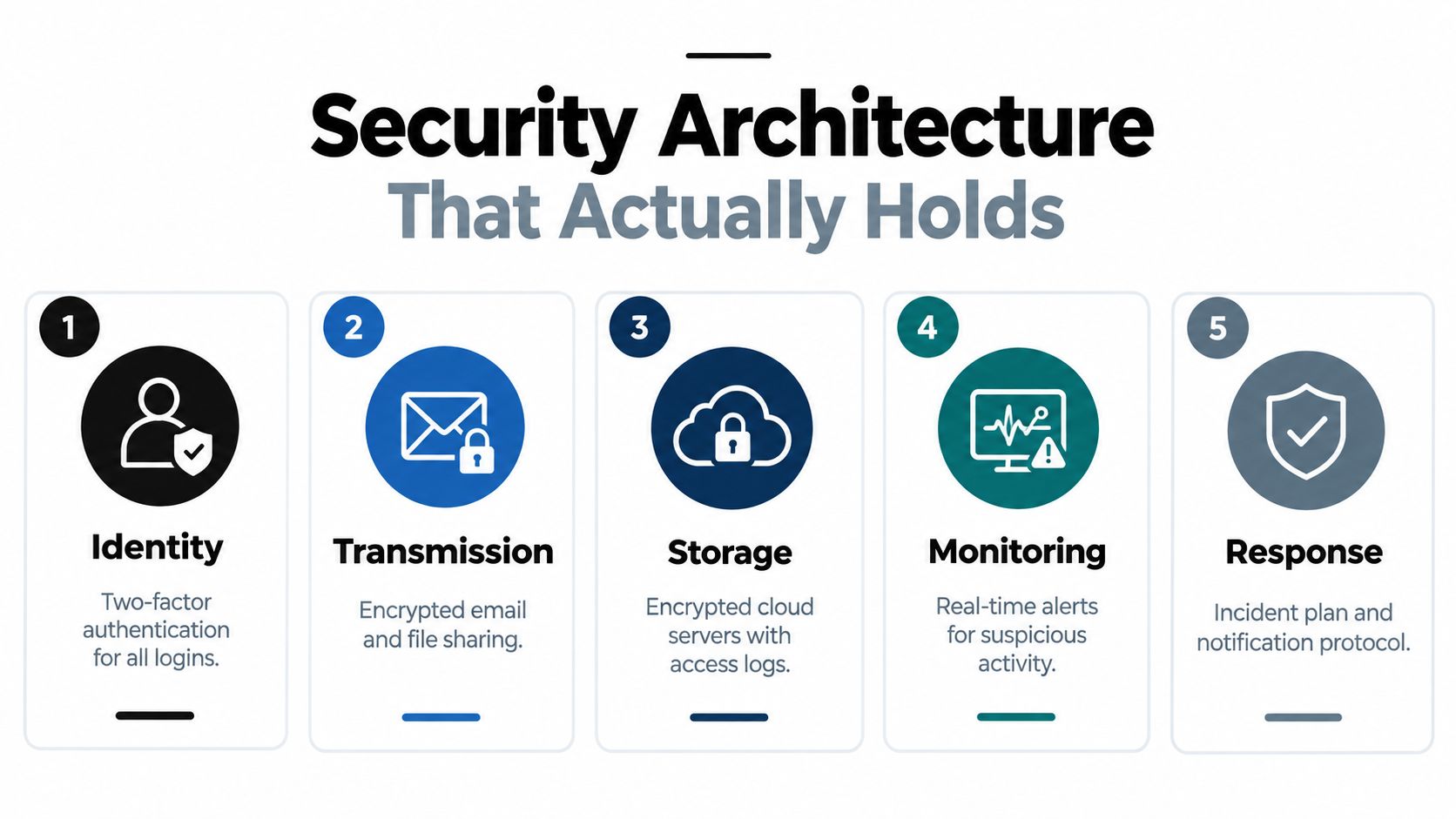
Bar guidance recommends physical, electronic, and procedural safeguards such as access codes, strong passwords, firewalls, malware protection, secure transmission and storage, and limiting disclosure of client-identifiable data where possible (security guidance for remote client files). Treat those as the baseline, not the finish line.
A firm should require:
- Identity controls. Multifactor authentication, strong passwords, and account-specific logins.
- Transmission controls. Encrypted file transfer and approved communication channels.
- Storage controls. Least-privilege, matter-based access and separate client workspaces.
- Monitoring controls. Immutable audit logs and regular access reviews.
- Disposal controls. Written retention and deletion schedules with proof of completion.
Each layer closes a different hole. Encryption helps during transfer, access segmentation limits damage if an account gets exposed, and logs let the lawyer trace what happened if a problem shows up later.
The 30-minute vendor check
Before a firm signs anything, the office manager should ask for the basics and stop if the answers are vague.
- Data residency: where the files live and where backups sit.
- Subcontractor disclosure: who else can see the matter.
- Breach timing: how fast the vendor has to notify the firm.
- Secure disposal: how deleted files are verified.
- Employee screening: what checks the vendor runs before access is granted.
- Security testing: evidence that the controls were tested.
The internal privacy checklist at Pipeline On’s privacy review tool is a good model for how tight this process should be. Vendor certification doesn’t replace your own periodic access review or spot-check testing, because the supervising lawyer is still accountable for reasonable efforts to prevent unauthorized disclosure.
Cross-Border and Compliance Risk Beyond the NDA
Offshore work isn’t automatically insecure, and domestic work isn’t automatically safe. The main issue is whether the vendor’s access, storage, and response rules match the matter’s risk profile.
When the matter should stay tight
Industry analysis flags GDPR, CCPA, HIPAA, cross-border data rules, and attorney-conduct obligations as overlapping compliance concerns, while also pointing to communication gaps and time-zone differences as practical risks (cross-border remote paralegal analysis). That combination is why some matters should stay domestic or stay in-house.
A medical-records dispute, a trade-secret case, or a file with sensitive immigration facts needs a tight access plan. If the firm can’t document where the data sits, who touches it, and how a breach gets handled, the file is too sensitive for casual outsourcing.
When offshore support still works
Offshore staffing can work when the firm controls the architecture. The question isn’t the map. The question is whether the vendor has the right permissions, device controls, retention rules, and incident response.
Use this filter:
- Source carefully: confirm the vendor’s supervision model and practice-area fit.
- Screen hard: ask how they handle client disclosure, conflicts, and escalation.
- Pilot one matter type: keep the first assignment narrow and review every deliverable.
- Review monthly: look at communication misses, access logs, and turnaround failures.
- Reject fast: if the vendor misses deadlines or can’t explain data handling, cut it.
The compliance note at Pipeline On’s data privacy guide is a useful reminder that process beats promises every time. A remote setup becomes acceptable only when the firm can show who handled what, where it lived, and how it was protected.
Sourcing, Vetting, and Running a Pilot Engagement
A good hire starts with the right questions, not the lowest quote. The best vendors make their supervision structure visible, because hidden supervision is usually no supervision at all.

Where to source and what to ask
ABA guidance treats competence, supervision, conflicts screening, confidentiality, client disclosure, and unauthorized-practice controls as core outsourcing obligations (ABA outsourcing opinion). That list should become your vendor checklist.
Source candidates from specialist directories, bar association registers, NALA-style networks, and referrals from firms that already supervise remote support well. Then ask direct questions:
- Named supervisor: who reviews the work, and how often.
- Escalation rules: what happens when the paralegal sees a legal issue.
- Turnaround standards: how deadlines are managed and confirmed.
- Error correction: how a mistake is reported and fixed.
- Audit trail: what records prove the work was reviewed.
Ask for the documents too. A serious vendor can produce a confidentiality agreement, scope of work, fee schedule, security questionnaire, and sample work order without drama.
How the pilot should run
Use the documentation workflow guide at Pipeline On’s workflow resource as the operating mindset. A pilot should be narrow, measurable, and easy to stop.
Run one matter type first, not the whole firm. Give the vendor a written assignment, a file naming rule, a turnaround deadline, and a review checkpoint. If the vendor misses the scope or blurs the attorney-paralegal line, stop the engagement before it spreads across the docket.
Non-negotiable: the first pilot should prove supervision quality, not just speed.
A 30-60-90 Day Rollout and the Questions Worth Asking First
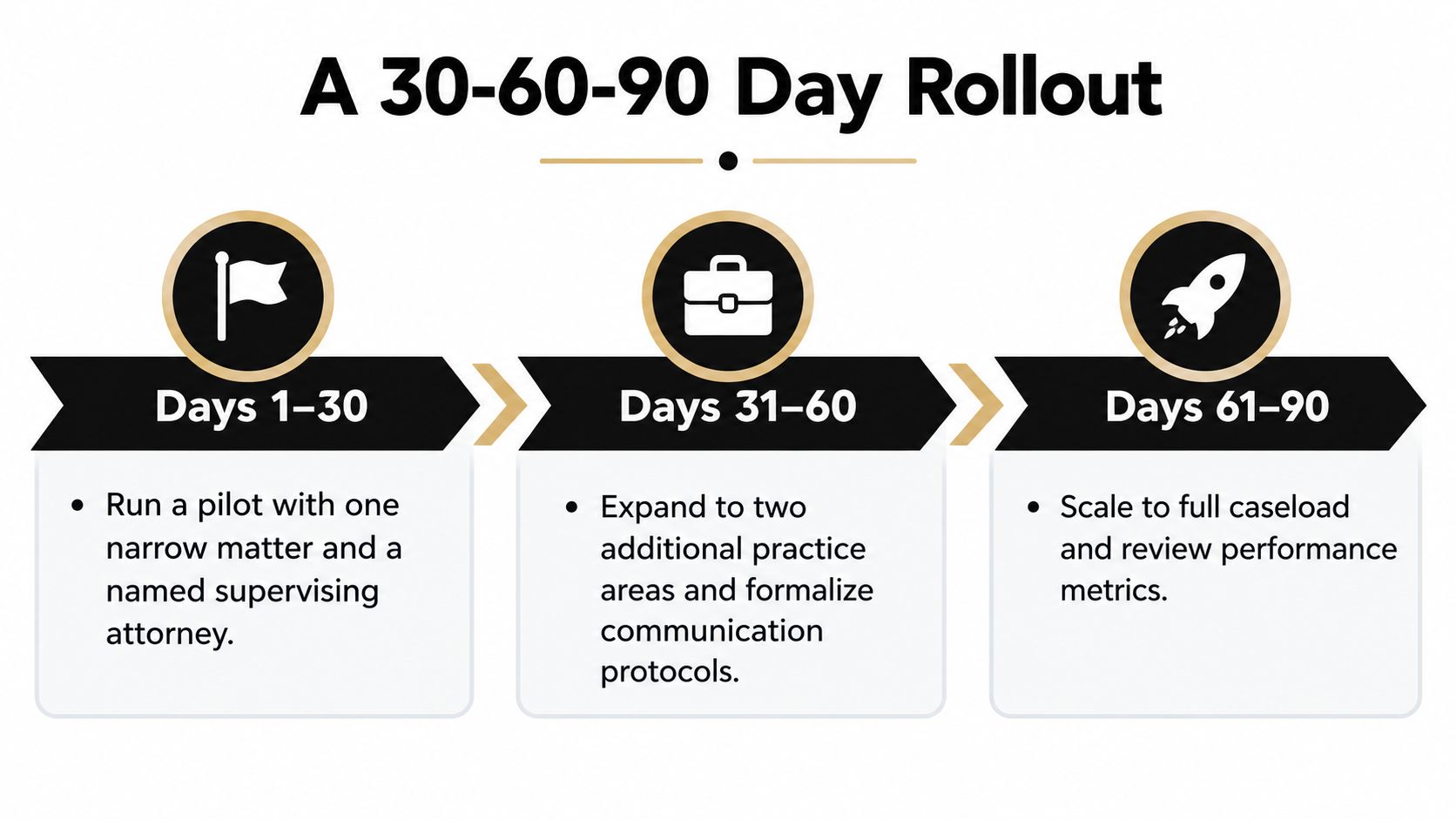
One bad handoff can cost more than a month of support savings. Start with a controlled pilot, one narrow matter type, and a named supervising attorney. Judge the vendor on clean work product, review speed, and whether the file rules are followed without constant correction.
Days 31 through 90
In the next phase, add only enough work to test supervision under pressure. Expand to two more matter types, review access logs, and sample the audit trail on a fixed schedule. Keep client disclosures documented and the scope tight enough that mistakes show up fast.
By the final phase, decide which pricing model fits the workload, write down escalation rules, and set the first quarterly security review. As noted earlier, the ABA summary of the NALA report showing flexible work arrangements in the profession points to a model that is already normal for many paralegals. The operational question is not whether remote support exists. It is whether your firm can supervise it, secure it, and terminate it cleanly if the vendor slips.
The questions that matter most
- How long does onboarding take? Long enough to prove supervision, short enough to fail fast if the fit is wrong.
- What happens when the paralegal makes a mistake? The lawyer owns the final work product, so the correction process has to be written before the first file moves.
- Does malpractice insurance extend automatically? Never assume so. Verify coverage in writing.
- How does the firm disengage cleanly? Build an off-ramp into the pilot, then cut access and retrieve files on a documented schedule.
Virtual paralegal services work only when supervision and security are treated as the product. If your firm handles contractor disputes, collections, vendor issues, or document-heavy files, start with a narrow pilot, named oversight, and a written security and review checklist.
Written by
Pipeline Research Team