10 Best Affiliate Marketing Niches for Contractors

96% of website visitors never convert on their first visit, which leaves contractors paying for demand they never identify or follow up with. That gap creates a practical affiliate opportunity. You can build useful content around the tools that capture website visitors, qualify inquiries, answer missed calls, automate follow-up, collect reviews, process payments, and keep your operation compliant.
The best affiliate marketing niches for contractors meet five tests: recurring commissions, urgent contractor pain, clear ROI, implementation fit, and a workable local or national audience. This roundup focuses on ten niches connected to the full customer-acquisition and operations workflow, from CRM and local SEO to call handling, reputation management, insurance, and payments.
Choose tools you understand well enough to explain to an HVAC owner, plumber, roofer, electrician, garage door company, or garden care specialist. Show where each product fits, what it replaces, which existing systems it connects to, and where adoption creates extra work. Check every program’s current terms, pricing, eligibility rules, and marketing restrictions before publication because affiliate programs and product claims change.
Table of Contents
- 1. CRM and Job Management Software for Home Services
- 2. Lead Generation and Website Visitor Identification Tools
- 3. Local SEO and Google Business Profile Management
- 4. Email Marketing and SMS Automation Platforms
- 5. Virtual Receptionist and Call Handling Services
- 6. Google Ads and PPC Management Services
- 7. Customer Review and Reputation Management Platforms
- 8. Website Design and Optimization Services for Contractors
- 9. Business Insurance and Bonding Services
- 10. Payment Processing and Invoicing Solutions
- Top 10 Home-Services Affiliate Niches Comparison
- Build an Affiliate Portfolio Around the Contractor Workflow
1. CRM and Job Management Software for Home Services
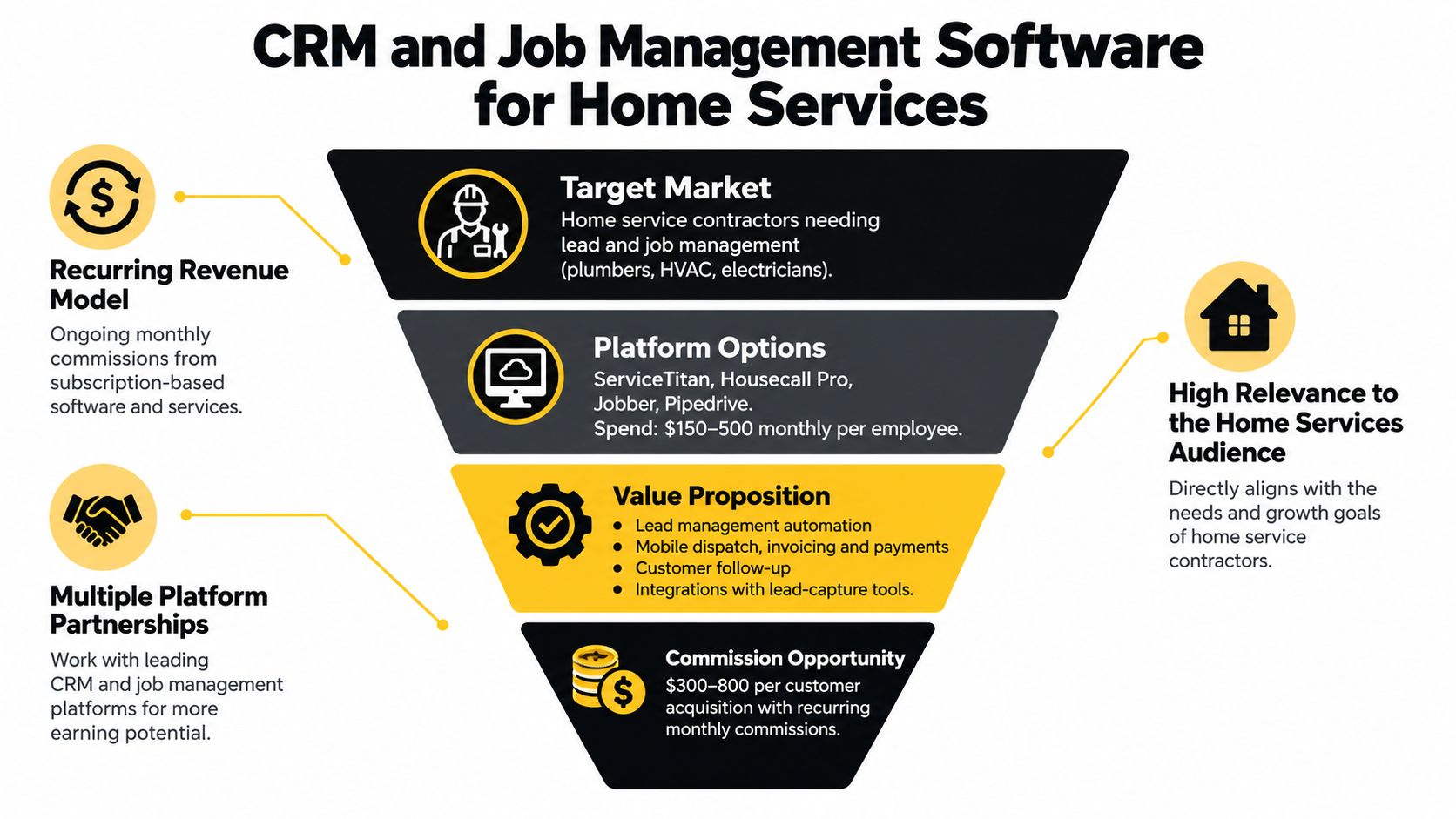
A contractor can generate plenty of inquiries and still lose revenue through slow responses, scheduling conflicts, incomplete estimates, and unpaid invoices. CRM and job management software gives you a strong affiliate niche because it sits at the operational center of the business. Platforms such as ServiceTitan, Housecall Pro, Jobber, and Pipedrive help teams organize leads, dispatch crews, manage customer records, issue invoices, and track follow-up.
Your content should begin with the contractor’s current workflow. A comparison for a plumbing company moving away from spreadsheets will attract a different buyer from a multi-location HVAC operator replacing disconnected systems. Explain setup, permissions, mobile access, reporting, customer communications, and integrations before discussing features.
Build content around migration risk
Contractors don’t want another software demo. They want to know whether a new system will disrupt scheduling, force a complete data migration, or leave technicians without the information they need in the field. Publish comparison guides, implementation walkthroughs, and “switching from spreadsheets” articles that answer those operational questions.
Link the platform to broader business infrastructure, including enterprise resource planning when a growing contractor needs deeper financial and resource coordination.
Practical rule: Recommend the system that fits the contractor’s current process, not the platform with the longest feature list.
Use this home-service CRM comparison once as an internal resource for readers evaluating software. A useful review should show how a lead enters the system, how an appointment gets assigned, and how the completed job triggers invoicing, review requests, and future maintenance reminders.
2. Lead Generation and Website Visitor Identification Tools
Contractors already spend money bringing people to their websites. The commercial problem begins when visitors browse service pages, check availability, or review financing information without submitting a form. Since 96% of website visitors don’t convert on their first visit, content around visitor identification and lead capture has an immediate operational hook. The supporting data is documented in this guide to identifying website visitors.
This niche includes lead-capture platforms, visitor identification software, conversion tools, and research products such as Hunter.io and RocketReach. For home-service companies, the best content focuses on recovering demand that already exists rather than promising an endless supply of new traffic.
Show the handoff into the CRM
A contractor needs to see what happens after identification. Demonstrate the alert, the contact record, the qualification step, and the follow-up sequence. Tutorials that connect a visitor-identification tool to ServiceTitan, Housecall Pro, Jobber, HubSpot, or Pipedrive will be more useful than generic software reviews.
Build content around abandoned inquiries, slow callback times, and service-page visitors who never complete a form. Include real implementation details, such as alert routing, contact verification, consent handling, and rules for separating homeowners from irrelevant traffic.
The strongest editorial angle is simple: improve the return from traffic the contractor already paid for. Avoid unsupported performance promises. Show the workflow, explain its limits, and tell readers which traffic sources and service pages deserve priority.
3. Local SEO and Google Business Profile Management
Local search determines whether a homeowner finds your company before calling another contractor. That makes Google Business Profile management, citation building, review monitoring, and local rank tracking durable affiliate subjects. Tools such as Semrush Local, BrightLocal, and Yext can support audits, listing consistency, review workflows, and visibility reporting for contractors serving defined areas.
Your content should speak to service-area realities. A roofer may need separate location and storm-damage pages, while an electrician may need clear service categories, emergency messaging, and accurate hours. A local SEO audit should examine the profile, website, service-area language, review activity, call tracking, and duplicate listings together.
Make the audit useful to a crew owner
Create articles such as “Is your Google Business Profile costing you leads?” Then show the reader how to inspect categories, service descriptions, photos, review responses, booking options, and location signals. Explain what the contractor can fix internally and what requires software or agency support.
Use this local SEO resource for contractors once as an internal link. You can also point readers to this detailed service business SEO guide when they need broader search strategy context.
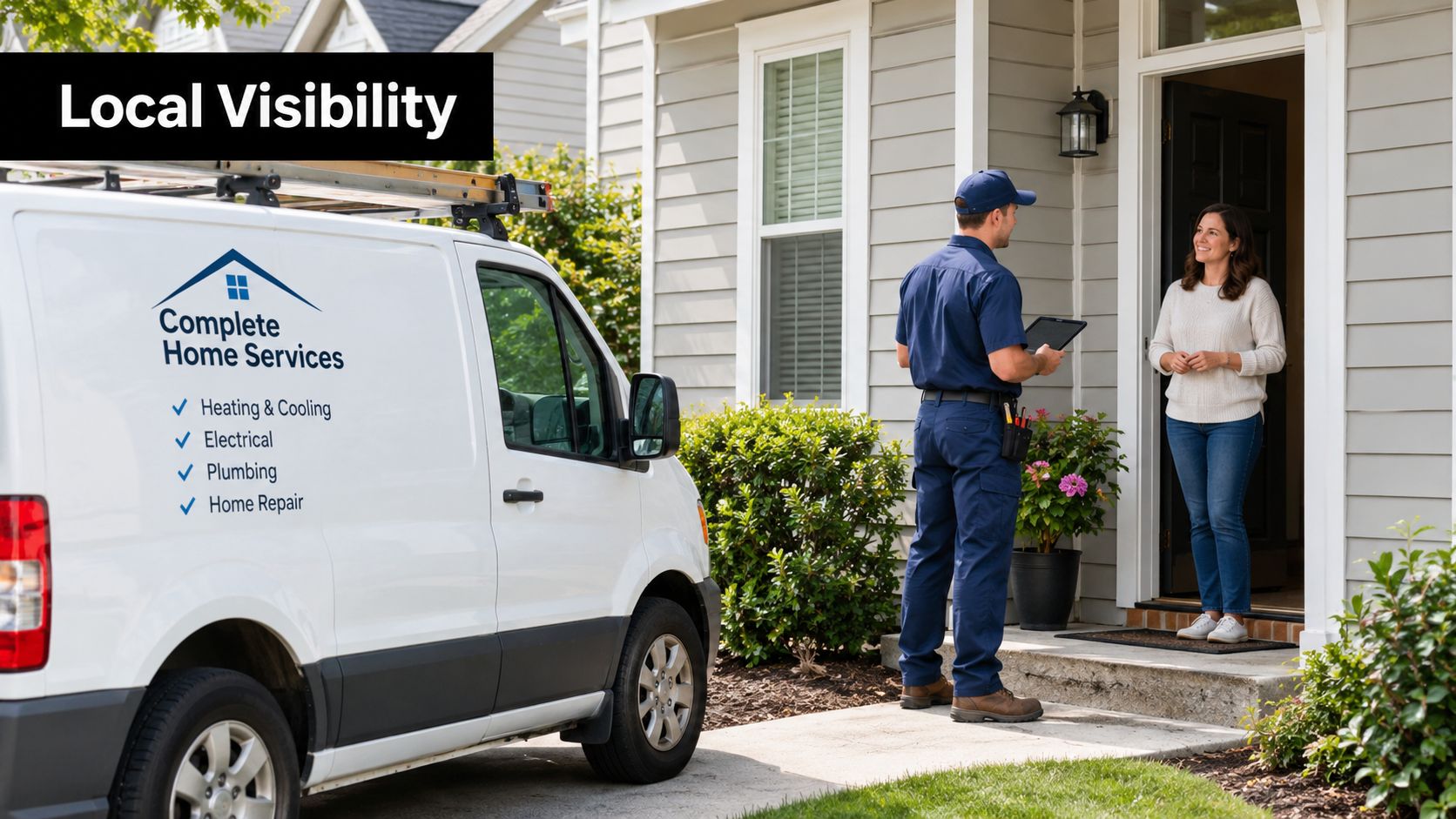
Review generation deserves special attention because it affects trust at the moment a homeowner compares providers. Promote tools that help the office request feedback after completed work, monitor new reviews, and respond consistently without asking technicians to manage another dashboard.
4. Email Marketing and SMS Automation Platforms
A lead that doesn’t book immediately still has value. Email and SMS platforms help contractors follow up after an inquiry, remind customers about seasonal work, promote maintenance plans, and reconnect with past clients before demand peaks. ActiveCampaign, Klaviyo, and Constant Contact are examples of products you can evaluate for different levels of automation and customer communication.
Contractors respond to ready-to-use sequences, not abstract advice about nurturing. Build templates for HVAC maintenance reminders, post-service check-ins, warranty notices, estimate follow-up, and seasonal plumbing or electrical campaigns. Show the trigger, message, timing, opt-out handling, and handoff to a salesperson.
Sell the second touch
A useful sequence can begin with an immediate reply to an inquiry, continue with a follow-up if the customer doesn’t respond, and then move into a longer education sequence. Keep the timing and language aligned with the service. A leaking water heater needs a different message from a non-urgent annual maintenance reminder.
SMS compliance must sit inside the recommendation. Explain consent, clear identification, opt-out requests, quiet hours, and record keeping. Contractors want automation that reduces manual work, but a careless campaign can create complaints and compliance exposure.
Affiliate content performs best when it connects automation to existing systems. Show how a CRM creates the trigger, how the platform sends the message, how replies reach the office, and how booked appointments stop the sequence. Compare ease of setup, segmentation, reporting, integrations, and the amount of ongoing maintenance the contractor’s team must handle.
5. Virtual Receptionist and Call Handling Services
A field crew can’t answer every call while driving, diagnosing equipment, working on a roof, or standing in a customer’s home. Virtual receptionists, live answering services, and AI call-handling platforms solve that coverage problem by answering inquiries, collecting job details, routing urgent requests, and scheduling appointments.
Start with a missed-call calculation suited to the reader’s operation. If a contractor receives 20 calls daily at a $150 average job value and misses eight calls, the missed opportunity is $1,200 per day, based on the example in the plan. Present that as scenario math, not as a universal business result. The contractor can replace the assumptions with actual call volume, close rate, and job value.
Evaluate the handoff, not just the greeting
A receptionist service earns its place when it captures accurate information and moves it into the workflow. Review call scripts, service-area rules, emergency escalation, appointment availability, recording policies, CRM integration, and after-hours coverage. A polished answer that creates an incomplete ticket still leaves the office with cleanup work.
Compare human answering with AI handling for different call types. A simple drain-cleaning request may follow a structured path, while a complex commercial HVAC inquiry may require experienced qualification. Content should explain where each model fits and when a contractor should use a hybrid approach.
After-hours and weekend coverage are strong angles because homeowners don’t follow office schedules. Show the exact information a caller needs to provide, then explain how the system alerts the office and prevents duplicate follow-up. Don’t publish unsupported appointment or revenue claims. Publish call-flow diagrams, script examples, and integration tests instead.
6. Google Ads and PPC Management Services
Paid search gives contractors immediate access to high-intent demand, but poorly configured campaigns can send budget toward broad searches, weak service areas, unqualified calls, or pages that don’t convert. This creates affiliate opportunities around Google Ads management, PPC optimization platforms, certified agencies, and white-label advertising services.
Target contractors already investing in paid acquisition. They have a clear budget, existing campaign data, and a reason to care about search terms, lead quality, call recordings, and booked-job revenue. A beginner contractor researching advertising needs education. An established roofer with active campaigns needs diagnosis.
Connect ads to the conversion layer
Create content that follows the journey from keyword to booked job. Review campaign structure, negative keywords, location settings, call tracking, landing-page relevance, form quality, and lead routing. Then explain how a lead-identification or capture platform can help recover visitors who don’t submit a form.
Use the message, “Your ads are running, but are they optimized?” as a starting point, then support it with an audit framework. Show readers how to distinguish a low-cost lead from a profitable booked job. A campaign can produce inexpensive inquiries that waste estimator time, while a higher-cost service-specific campaign may create better opportunities.
Compare managed agencies with software. Agencies provide strategy and execution, but contractors depend on their reporting and communication. Software offers control, but someone on the contractor’s team must interpret data and make changes. Include contract terms, account ownership, access permissions, landing-page responsibilities, and the process for pausing bad campaigns.
7. Customer Review and Reputation Management Platforms
Reviews influence whether a homeowner trusts a contractor enough to call. Reputation-management software helps teams request feedback after completed work, monitor listings, respond to reviews, and identify service issues before they become public complaints. Birdeye, BrightLocal, and Podium give you concrete products to compare for contractor audiences.
The strongest content follows the job lifecycle. A completed invoice should trigger a review request, the customer should receive a simple path to respond, the office should monitor new feedback, and staff should answer reviews consistently. That workflow belongs beside the CRM and payment discussion, not in a disconnected marketing dashboard.
Build the review workflow around the job
Show the contractor how to configure a request after completion, customize messages by trade, route negative feedback internally, and respond to public reviews without exposing private customer details. A roofing company can ask about communication and cleanup, while an HVAC company may focus on punctuality, explanation, and comfort after the repair.
A contractor’s team also needs a response policy. Define who owns replies, how quickly the office responds, which complaints require a manager, and when the company should take a conversation offline. Software can automate requests and monitoring, but it can’t replace judgment.

Affiliate content should also cover review authenticity and platform rules. Don’t encourage review gating, fabricated feedback, or incentives that violate a platform’s policies. Show how reputation tools fit into the contractor’s real process, then compare automation depth, messaging channels, reporting, and integration quality.
8. Website Design and Optimization Services for Contractors
Your website has to help a homeowner decide quickly. A service-area visitor should understand what you repair, where you work, why your crew is credible, and how to contact you without hunting through menus. That makes contractor-focused website builders, design services, landing-page tools, and conversion optimization products useful affiliate subjects.
Review a website through the customer’s phone, not the owner’s desktop. Check the prominence of the phone number, tap targets, form length, service pages, financing or warranty information, reviews, emergency instructions, and confirmation message after submission. A visually attractive site can still bury the contact path.
Review the page as a dispatcher would
Create before-and-after analyses that identify specific changes, such as moving the call button, clarifying service areas, separating emergency and routine requests, or adding proof near the form. Don’t claim a conversion lift without real evidence. Use annotated screenshots, usability observations, and test plans instead.
Contractor-specific options such as Buildable can be compared with general platforms such as Weebly, while agencies may offer white-label design and optimization services. Explain the trade-off between control and support. A platform can reduce cost and simplify edits, while an agency can handle strategy, copy, design, analytics, and technical maintenance.
Mobile performance deserves its own review criteria because crews and homeowners interact with the site away from a desk. Connect the website to the rest of the workflow by showing how forms, calls, visitor identification, CRM records, and follow-up operate together. The affiliate recommendation becomes more credible when it explains the complete handoff rather than treating web design as a standalone purchase.
9. Business Insurance and Bonding Services
Insurance and bonding solve a requirement that affects whether contractors can bid, operate, and maintain customer confidence. Relevant products include general liability, workers’ compensation, commercial auto, and contractor bonds. This niche works because every recommendation must account for trade, employees, vehicles, licensing, contract requirements, and the jobs the company accepts.
The content needs a compliance-first angle. Explain what information a contractor should gather before requesting a quote, such as business structure, trade classification, payroll details, vehicle use, subcontractor arrangements, and claims history. Help the reader compare coverage limits, exclusions, certificates, additional insured requests, and renewal responsibilities.
Keep the recommendation specific to the trade
A solo handyman, an HVAC company with technicians, and a roofing contractor with subcontractors face different exposure. Generic insurance content attracts broad traffic but gives poor guidance. Build pages for a trade and operating model, then tell readers to confirm requirements with a licensed insurance professional.
Use a broader business setup bundle as the editorial frame. A contractor may need a CRM, a conversion-ready website, payment tools, and appropriate insurance as the company grows. The affiliate opportunity comes from solving the connected operational problem, not from pushing a policy in isolation.
For coverage basics, include this contractor general liability insurance guide once. State affiliate relationships clearly, avoid promising approval or savings, and don’t interpret a policy for a reader. Insurance terms, underwriting decisions, and legal obligations require current verification.
10. Payment Processing and Invoicing Solutions
A completed job doesn’t improve cash flow until the contractor collects payment. Payment processing and invoicing tools help crews accept cards or digital payments in the field, send professional invoices, track balances, automate reminders, and connect financial activity to the job record. Square, Stripe Connect, and Toast provide recognizable examples for comparison content, subject to current program and product availability.
Open with the operational delay. A technician finishes the work, leaves the property, and the office later prepares an invoice. That extra handoff creates room for missing details, delayed payment, and repeated follow-up. Mobile payment acceptance can shorten the path from completion to collection when the customer and contractor agree to the payment method.
Review the full payment path
A useful affiliate review follows the process from estimate to final receipt. Cover deposits, change orders, card acceptance, financing options where available, refunds, partial payments, invoice reminders, reconciliation, and CRM synchronization. Contractors need to know who sees payment status and how the office handles failed transactions.
Compare subscription fees, processing costs, hardware, payout timing, permissions, reporting, and support. Don’t present a fee as universally best because the right choice depends on transaction mix, average ticket, payment method, and integration requirements. Explain what the contractor must verify before switching.
Content can target trade-specific scenarios, such as collecting an emergency service payment on-site, taking a deposit for a replacement project, or sending a recurring maintenance invoice. The best recommendations show how payment data moves into job management and how reminders reduce office labor without creating an unpleasant customer experience.
Top 10 Home-Services Affiliate Niches Comparison
| Item | Implementation Complexity 🔄 | Resource Requirements ⚡ | Expected Outcomes ⭐📊 | Ideal Use Cases 💡 | Key Advantages ⭐ |
|---|---|---|---|---|---|
| CRM and Job Management Software for Home Services | Medium–High 🔄, integrations, staff training | Moderate–High ⚡, per-employee subscriptions ($150–500/mo), onboarding | High ⭐📊, better scheduling, higher lead-to-job conversion, measurable ROI | Established contractors scaling teams and workflows | High relevance, recurring affiliate commissions, strong integrations |
| Lead Generation & Website Visitor Identification Tools | Medium 🔄, tracking, lead scoring setup | Moderate ⚡, platform fees + sufficient website traffic | High ⭐📊, more qualified leads, improved conversion from existing traffic | Contractors with existing site traffic who need conversion lift | High LTV commissions, immediate ROI when traffic present |
| Local SEO & Google Business Profile Management | Medium 🔄, audits and ongoing optimization (60–90 days) | Low–Moderate ⚡, monthly tooling and time for listings | Medium–High ⭐📊, sustained organic visibility, reduced paid ad spend | Contractors competing locally or relying on organic leads | Long-term traffic gains, lower CPC dependence, strong affiliate tools |
| Email Marketing & SMS Automation Platforms | Low–Medium 🔄, templates and automation flow setup | Low ⚡, affordable subscriptions, content creation time | High ⭐📊, improved follow-up and retention; strong ROI per spend | Contractors needing consistent lead nurture and repeat business | Low barrier to entry, immediate conversion lift, recurring commissions |
| Virtual Receptionist & Call Handling Services | Low–Medium 🔄, script and integration setup | Moderate ⚡, monthly service fees, training/QA | High ⭐📊, recapture missed calls, measurable revenue recovery | Field crews missing calls or needing after-hours coverage | Immediate lead capture, high LTV commissions, measurable ROI |
| Google Ads & PPC Management Services | High 🔄, strategy, continuous optimization | High ⚡, ad spend + management fees and expertise | High ⭐📊, fast lead volume and measurable ROAS if optimized | Contractors spending $1k+/mo on ads seeking efficiency | High-value clients, clear ROI messaging, recurring management fees |
| Customer Review & Reputation Management Platforms | Low–Medium 🔄, workflow setup and staff engagement | Low ⚡, platform fees and time to request reviews | Medium–High ⭐📊, higher conversion rates and improved local rankings | Contractors aiming to improve trust and local search presence | Direct conversion impact, complements CRM, recurring revenue |
| Website Design & Optimization Services for Contractors | Medium–High 🔄, design, testing, performance tuning | Moderate–High ⚡, development, hosting, maintenance costs | High ⭐📊, 2–3x more lead submissions with optimized sites | Contractors with poor/mobile sites or rebranding needs | Clear visual ROI, high commissions, bundles with other tools |
| Business Insurance & Bonding Services | Medium 🔄, policy selection, underwriting nuances | Low–Moderate ⚡, annual premiums, compliance requirements | Steady ⭐📊, required protection, renewal-based revenue | Licensed contractors needing compliance to bid work | Universal demand, high affiliate commissions, annual renewals |
| Payment Processing & Invoicing Solutions | Low 🔄, simple integration with CRM/accounting | Low ⚡, transaction fees and possible monthly plans | Medium–High ⭐📊, faster payments and improved cash flow | Contractors needing on-site payments and quicker settlements | Universal need, transaction-based recurring commissions, improves cash flow |
Build an Affiliate Portfolio Around the Contractor Workflow
The strongest contractor affiliate portfolio follows the way a lead becomes revenue. Start with one operational foundation, add one demand-generation category, then connect a conversion layer. This structure keeps your content useful to contractors and prevents a site from becoming a random catalog of software links.
For the foundation, choose CRM and job management or payment and invoicing. A CRM recommendation helps a contractor organize leads, estimates, scheduling, jobs, and customer history. A payment recommendation addresses collection, reconciliation, and office workload. Pick the area where your audience has the clearest current pain and where you can explain implementation in practical detail.
For demand generation, choose local SEO or PPC. Local SEO content can target Google Business Profile cleanup, service-area visibility, reviews, citations, and rank tracking. PPC content can target campaign structure, lead quality, landing pages, call tracking, and budget control. Keep the trade-off visible. Organic visibility takes sustained work, while paid search requires ongoing budget and active optimization.
The conversion layer can include visitor identification, call handling, SMS automation, or reputation management. These categories work best when you show exactly where they connect to the foundation and demand source. For example, a contractor may use local SEO to attract a homeowner, a visitor-identification platform to recover a non-form submission, a CRM to store the profile, and SMS or email to continue the conversation. A missed call can enter a receptionist workflow, create a job record, trigger a confirmation, and later request a review.
Pipeline On fits naturally into this conversion-layer model for contractors who already pay for website traffic. Its lightweight script identifies names, addresses, and emails associated with homeowners who browse without submitting a form, then can sync profiles with tools including ServiceTitan, Housecall Pro, Jobber, HubSpot, and Pipedrive. It also supports follow-up through email, SMS, or next-day postcards, with Hot Pages, Hot Leads, Slack alerts, email alerts, and Zapier connections helping teams prioritize outreach.
Choose a narrow audience for every page. “Best CRM for HVAC contractors in Phoenix” gives you a clearer editorial assignment than a general software roundup. Build pages for plumbers handling emergency calls, roofers responding to storm demand, electricians managing service areas, garage door companies booking same-day work, or landscapers scheduling recurring visits. Include implementation evidence, screenshots where permitted, workflow diagrams, honest limitations, and clear disclosure that you may earn from referrals.
Verify current program terms before publishing or refreshing content. Check commission structure, cookie duration, attribution rules, payout thresholds, brand bidding restrictions, geographic eligibility, cancellation policies, and prohibited claims. Pricing and product capabilities change, so date your comparisons and revisit them on a defined schedule.
Your affiliate recommendations should earn trust before they earn commissions. Test the workflow, speak with contractors who use the category, show what the office and field crew must do, and explain when a product creates more complexity than value. A focused site that solves measurable contractor problems can compete through relevance, implementation detail, and trade-specific authority.
Pipeline On helps home-service contractors identify homeowners who browse their websites without submitting forms, connect those profiles with existing tools, and trigger follow-up through email, SMS, or postcards. Use it as the conversion layer in your contractor affiliate content strategy, and visit Pipeline On to see how it can fit your lead-recovery workflow.
Written by
Pipeline Research Team